

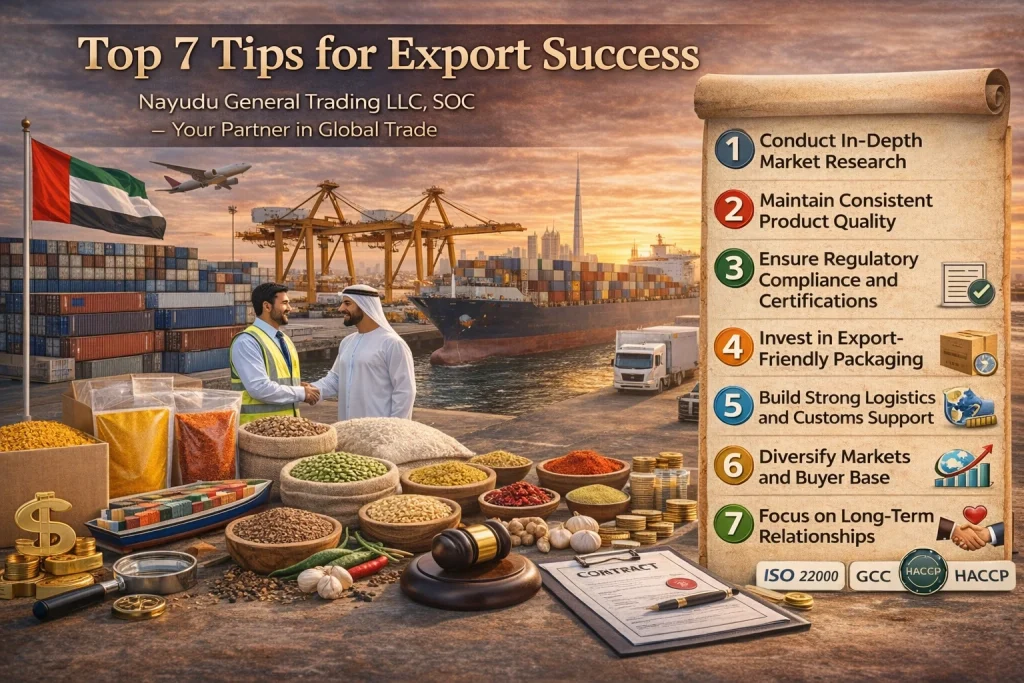
Top 7 Tips for Export Success
The global export–import industry is evolving faster than ever, driven by changing consumer behavior, stricter regulations, digitalization, and shifting supply chains. For exporters dealing in foodstuff and agricultural commodities, staying competitive in 2026 will require a strategic, well-structured approach. Businesses that focus on quality, compliance, and strong partnerships will be better positioned to achieve long-term success.
Here are seven essential tips to help exporters build a strong and sustainable presence in international markets.
1. Conduct In-Depth Market Research
Before entering any market, exporters must understand demand patterns, pricing structures, import regulations, and consumer preferences. Each country has different standards for labeling, packaging, and food safety. Proper research reduces risk and ensures products meet local requirements from the start.
2. Maintain Consistent Product Quality
Quality is the foundation of successful exporting. Buyers expect uniformity in appearance, taste, size, and packaging. Implementing strict quality control at sourcing, processing, and packing stages helps maintain consistency. Exporters who deliver reliable quality gain repeat customers and long-term contracts.
3. Ensure Regulatory Compliance and Certifications
Exporters must comply with international food safety standards and documentation requirements. Certifications and laboratory test reports enhance credibility and simplify customs clearance. Staying updated with regulatory changes avoids delays and penalties.
4. Invest in Export-Friendly Packaging
Packaging plays a vital role in protecting products and attracting buyers. Moisture-resistant, food-grade, and well-labeled packaging preserves freshness during long transit periods. Attractive packaging also strengthens brand perception in competitive markets.
5. Build Strong Logistics and Customs Support
Reliable freight forwarders and customs agents are crucial for smooth operations. Efficient logistics planning minimizes transit time, reduces costs, and ensures on-time deliveries. A strong logistics network allows exporters to handle large volumes confidently.
6. Diversify Markets and Buyer Base
Relying on a single market increases business risk. Exporters should target multiple regions such as the GCC, Africa, Asia, and Europe to balance demand fluctuations. Diversification creates stability and opens new growth opportunities.
7. Focus on Long-Term Relationships
Export success is built on trust. Transparent communication, timely deliveries, and consistent quality strengthen relationships with buyers and suppliers. Long-term partnerships lead to repeat orders, better pricing, and sustainable growth.
At Nayudu General Trading LLC, SOC, these principles guide our export operations. By combining market knowledge, quality-driven processes, and customer-focused service, we help our partners succeed in global trade. As international demand for foodstuff and agricultural commodities continues to grow, exporters who adopt these best practices will remain competitive and profitable in 2026 and beyond.